
Why 2026 Is the Year Businesses Replace Traditional Answering Services with AI Voice Agents
AI Voice, Customer Experience, Business Operations
In 2026, AI voice technology has moved from experimental to essential. As customers expect instant, accurate, and always‑on responses, businesses are discovering that traditional answering services can no longer keep up—while AI voice agents quietly deliver faster, smarter, and more cost‑effective call handling at scale.
1. Cost Comparison: Unlimited Capacity for a Fraction of the Price
Traditional answering services were designed for a different era. Many still charge $500 or more per month for a limited pool of minutes, plus overage fees when call volume spikes. That model makes every extra inquiry feel like a cost burden rather than a growth opportunity, especially for service businesses that rely on phone calls to generate revenue.
Modern AI voice agents invert that equation. For around $199 per month, businesses can access effectively unlimited calls without worrying about minute bundles or surprise invoices. Once deployed, AI infrastructure scales at marginal cost, which is why analysts expect AI‑driven customer interactions to dominate by mid‑decade, with Gartner projecting AI to handle around 70% of customer interactions by 2026.
The result is straightforward: the same budget that once covered a constrained, human‑only answering service can now fund a 24/7 intelligent front line that never runs out of minutes and never needs overtime pay. For many businesses, this single line‑item shift unlocks a step‑change in both service quality and profitability.
2. Speed & Availability: From 20–45 Seconds to Under 5 Seconds
In a world where customers can tap a competitor’s number in seconds, speed is non‑negotiable. Traditional answering services frequently introduce delays—calls ring at your business, roll over to the service, wait in a queue, and then finally reach an operator. That often means 20–45 seconds before a human even says “hello.”
AI voice agents operate differently. Built on ultra‑low‑latency speech‑to‑speech models that now respond in just a few hundred milliseconds, they can answer on the first ring—typically under five seconds. There is no rollover, no queue, and no “please hold while I pull up your account.” The agent is ready the instant the call connects, any time of day, any day of the year. Industry reports note that modern voice AI has reached near human‑like conversational speed, with end‑to‑end pipelines delivering responses in 200–500 ms.
This matters because callers rarely distinguish between your “answering service” and your brand. Every ring and every second of silence erodes trust. By guaranteeing sub‑five‑second responses 24/7, AI voice agents set a new baseline for responsiveness that traditional services simply cannot match without unsustainable staffing costs.
3. Accuracy & Integration: From Message Taking to Real Execution
Traditional answering services are, at their core, message takers. An operator writes down a name, number, and a brief summary, then emails or texts it to your team. Every handoff introduces the risk of misspelled names, wrong numbers, incomplete notes, or lost messages. Your staff must then re‑enter that data into your CRM, calendar, or ticketing system—another opportunity for errors and delays.
AI voice agents eliminate this friction. Because they’re built to integrate directly with platforms like HubSpot, Salesforce, and Google or Microsoft calendars, they can:
Capture and sync 100% of lead data—name, contact details, intent, call transcript—directly into your CRM in real time.
Book appointments instantly on your team’s live calendars, respecting availability rules and meeting types.
Trigger workflows—like follow‑up emails, SMS confirmations, or internal alerts—without any manual intervention.
Instead of “You have a new message,” your team arrives each morning to fully created records, scheduled meetings, and complete call histories. This level of accuracy and automation is exactly why major enterprises are standardizing on AI voice as a core part of their customer‑service infrastructure.
4. Scalability: Handling Spikes Without Busy Signals or Long Holds
Call volume is rarely steady. New campaigns, seasonal peaks, or unexpected events can generate sudden surges in inquiries. Traditional answering services are bound by the number of people on shift. When call volume exceeds capacity, customers face busy signals, long holds, or dropped calls—all of which translate directly into lost revenue and damaged reputation.
AI voice agents were engineered for precisely this challenge. Because they run on elastic cloud and edge infrastructure, a single deployment can manage hundreds or thousands of simultaneous conversations without degradation. For the caller, it simply feels like your business always has someone free to pick up immediately. For you, it means you never have to guess how many operators to staff for the “just in case” spike.
Research on AI voice adoption highlights this scalability as a primary driver of enterprise investment: AI systems can be “easily scaled up or down based on demand without significant overhead”. In practical terms, that means your phone experience remains consistent on your slowest Tuesday and your busiest launch day—without adding a single headcount.
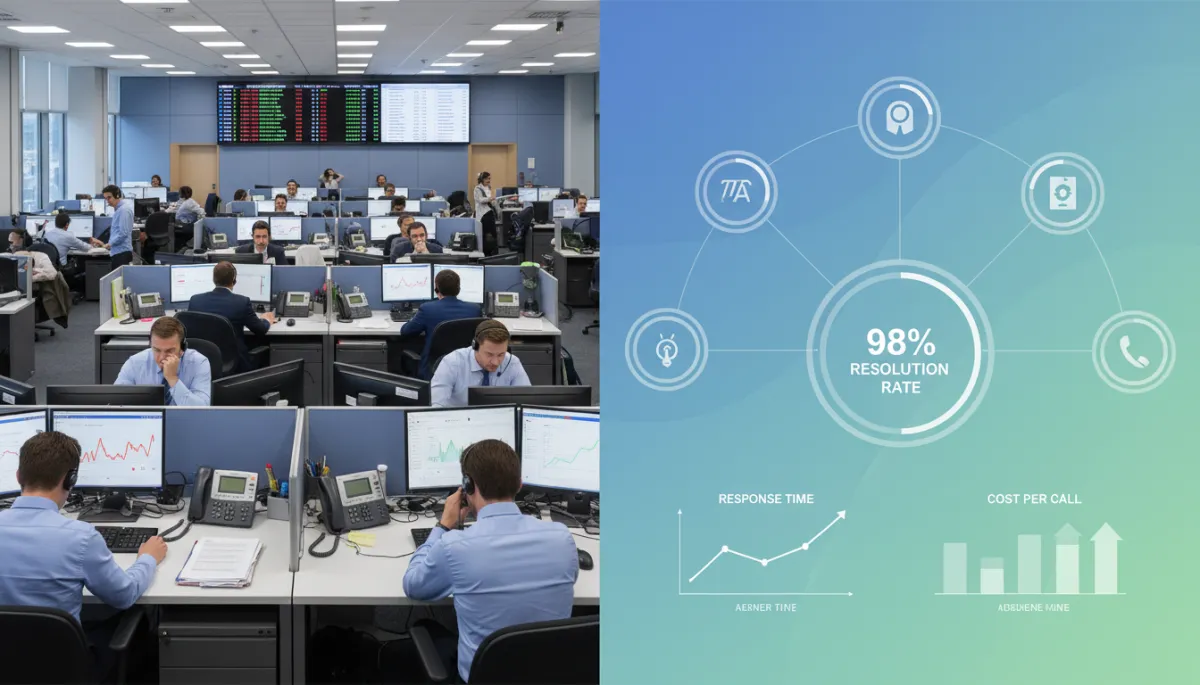
AI voice agents absorb call spikes effortlessly, avoiding busy signals and abandoned calls.
5. The “Human” Myth: Why Callers Prefer Capable AI Over Scripted Operators
A common objection to AI voice agents is, “Our customers want a human.” In reality, what most customers want is resolution: fast answers, accurate information, and the ability to get something done on the first call. Traditional answering services often provide a friendly voice—but that voice is typically reading from a rigid script and cannot actually complete tasks inside your systems.
Modern AI, powered by advanced natural language processing and real‑time integrations, changes that equation. Today’s voice agents can:
Handle routine FAQs—pricing, hours, policies, directions—with natural, conversational language.
Check availability and book appointments in real time, without putting anyone on hold.
Capture detailed context and route complex issues to the right human with a full, structured summary attached.
Industry leaders now describe voice as the “next major interface” for AI, noting that models can incorporate emotion, prosody, and reasoning to create interactions that feel natural and efficient (TechCrunch, 2026). When callers experience an agent that answers immediately, understands them, and actually solves their problem, they rarely complain that it was not a human. In fact, many prefer the speed and capability over a polite operator who can only promise, “Someone will call you back.”
6. Why 2026 Is the Inflection Point—And What Forward‑Thinking Businesses Do Next
Several forces are converging in 2026: ultra‑low‑latency voice models, mature CRM and calendar integrations, and proven enterprise deployments across industries. At the same time, customers have grown accustomed to instant digital experiences everywhere else in their lives. Keeping a traditional answering service in place now means paying more for slower, less accurate, and less scalable call handling than your AI‑enabled competitors.
Replacing a legacy service with an AI voice agent is no longer a risky experiment; it is a pragmatic upgrade. For roughly $199 per month, businesses can move from message‑taking to full‑funnel call automation: instant pickup, precise data capture, direct CRM sync, live appointment booking, and elastic capacity that grows with demand. Human teams are then free to focus on high‑value, high‑empathy interactions where they truly add value.
For organizations serious about growth, customer experience, and operational efficiency, 2026 is not just another year on the calendar. It is the moment when sticking with a traditional answering service becomes a strategic liability—and when adopting AI voice agents becomes a clear, forward‑thinking competitive advantage.
Ready to see what AI voice could do for your phones? Book a 15‑minute demo to hear a live agent in action, walk through real call flows for your business, and get a tailored rollout plan for the next 30 days.
